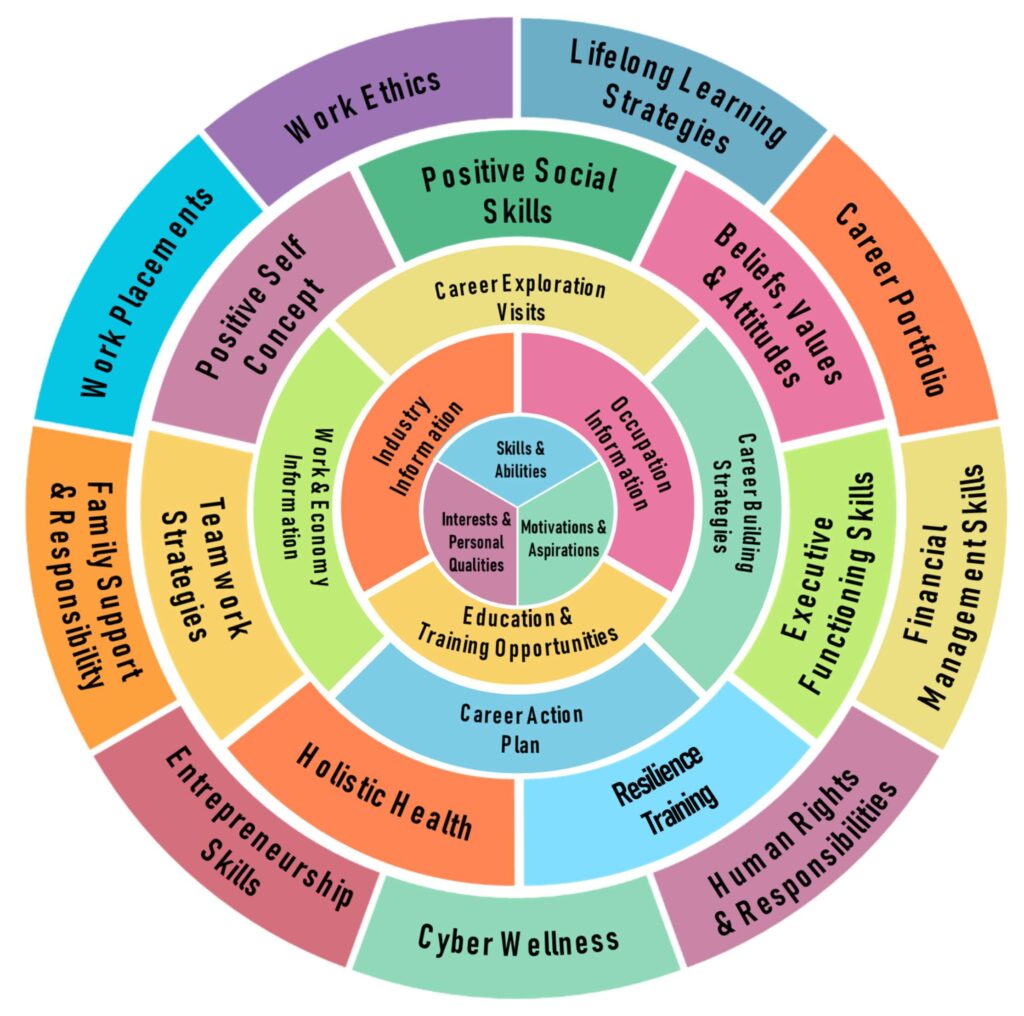
Our Curriculum - The 26 Career Elements

Our career programmes are built on a dynamic curriculum comprising 26 essential Career Elements. This comprehensive framework guides individuals through their career journeys across all life stages, from early education through adulthood.

Here’s why our Curriculum stands out:

1. Positive Self-Concept

A positive self-concept is fundamental for all life and career decisions, enabling individuals to believe in themselves. This fosters the pursuit of growth opportunities, encourages taking chances, and improves resilience in handling failure and disappointment.

2. Skills and Abilities

Understanding the required knowledge, skills, and abilities (KSAs) for specific careers is essential. Individuals must learn and excel in the KSAs relevant to their desired work. Future-ready individuals need KSAs to meet complex demands in new occupations and unknown scenarios.

3. Interests and Personal Qualities

Identifying personal interests (what you like to do at work) makes careers more enjoyable and motivates better performance. Recognizing and leveraging character strengths from personal qualities helps in choosing careers where these strengths can shine.

4. Beliefs Values and Attitudes:

Understanding one’s own beliefs, values, and attitudes is crucial for self-awareness and making informed life and career decisions. These internal drivers shape behavior, influence career choices, and dictate how individuals interact in professional environments. Critically, aligning personal values with an organization’s culture is essential for job satisfaction, long-term success, and thriving in the workplace.

5. Motivations, Aspirations, and Priorities

Motivation drives individuals towards goals. Aspirations are future-oriented and influenced by conscious and unconscious motivations, shaping the capabilities strived for and life/career priorities. Understanding these elements helps in making important decisions and career choices.

6. Pro-Social Skills

Developing pro-social skills is essential for success in both academic and professional environments. These skills form the foundation for empathy and mindfulness, fostering positive interactions in teams and with colleagues. They are critical for collaboration and building a supportive work environment.

7. Teamwork Strategies

Being an effective team member is a highly sought-after characteristic by employers. It involves aligning individual efforts with organizational success, valuing diverse strengths, and collaborating to achieve goals efficiently and to high standards. This also encompasses managing stress and practicing assertiveness within a team context.

8. Holistic Health - Mental and Physical Wellness

Focusing on physical and mental well-being is paramount for career success. A healthy lifestyle provides the necessary energy, improves work habits, increases productivity, and enhances opportunities for career advancement. This also includes stress management and mindful meditation.

9. Cyber Wellness (CW)

Cyber wellness teaches individuals how to protect themselves in digital spaces, both personally and professionally. Understanding the safe and responsible use of digital and social media is vital for both individual safety and organizational security. This includes managing digital identity and navigating cyberbullying.

10. Resilience Training

Resilience training enhances the ability to recover from stressful situations, providing a key strategy for tackling workplace stress, competitive job markets, conflicts, and challenges in both professional and personal life. It’s about developing conscientiousness and mindfulness.

11. Lifelong Learning Strategies

Lifelong learning is the continuous process of gaining valuable skills and knowledge, and mastering effective learning strategies. Continuing education and upskilling in new technologies are prerequisites for career growth and reaching full potential. This includes effective study habits and note-taking.

12. Education and Training Opportunities

Identifying and utilizing available education and training opportunities is vital for career progression and skill enhancement. This includes understanding pathways to higher education, vocational training, apprenticeships, and industry certifications. It’s about strategically leveraging resources to gain competitive advantages.

13. Occupation Information

Understanding occupation information means grasping how different jobs are grouped by shared tasks, skills, and required qualifications. It involves exploring various occupational clusters, typical work functions, and the education/training pathways associated with them. This systematic understanding helps individuals make informed career exploration decisions and better connect their skills to potential roles.

14. Industry Information

Understanding industry information means knowing how businesses are grouped and the economic trends within those groupings. It involves identifying growing versus declining industries, both locally and nationally, and being aware of emerging industries. This knowledge allows individuals to strategically target sectors with strong future prospects, aligning their career choices with labor market demands.

15. Career Exploration and Visits

Career exploration and planning involve researching various career fields, understanding job requirements, and strategically mapping out a career path. This includes setting short-term and long-term goals, identifying necessary education or training, and understanding potential growth trajectories within a chosen field.

16. Work and Economy Trends

Understanding work and economy trends means staying abreast of shifts in the labor market, economic indicators, and global business environments. This includes identifying growing sectors, emerging job roles, and the impact of technological advancements on work. It also involves recognizing how education and skills align with economic needs, enabling individuals to make informed and adaptable career choices.

17. Entrepreneurship Skills

Cultivating an entrepreneurial mindset involves identifying opportunities, developing innovative solutions, and understanding the process of creating and managing new ventures. This includes fostering creativity, risk assessment, and resourcefulness, whether starting a business or being entrepreneurial within an existing organization.

18. Work Ethics

A strong work ethic is fundamental to professional success and involves cultivating habits of diligence, responsibility, and commitment in the workplace. It means being personally accountable for tasks, demonstrating initiative, being dependable, and consistently striving for high-quality outcomes. Developing a robust work ethic allows individuals to perform effectively and build a positive reputation with employers.

19. Executive Functioning Skills

Executive Functioning Skills are vital for developing competencies like goal setting and achievement, sustained focus, and impulse control. They enable individuals to stay focused on tasks, resist distractions, manage their thoughts, and flexibly adapt to new challenges or priorities in the workplace. These skills are often more critical than raw intelligence for long-term career and life success, fostering consistent effort towards goals.

20. Financial Management Skills

Effective financial management is a critical life skill that directly impacts career stability and overall well-being. It involves budgeting, saving, understanding credit, and planning for future financial goals, including retirement. Sound financial practices reduce stress and enable individuals to make career choices based on passion rather than solely on immediate need.

21. Family Support and Responsibility

Understanding the interplay between work and family life is crucial for achieving overall well-being and career stability. This element highlights the importance of family support in mitigating stress and work-family conflict, leading to increased job satisfaction. It also recognizes how family values and responsibilities shape career aspirations and choices throughout one’s life.

22. Human Rights and Responsibility

Understanding human rights and our corresponding responsibilities is fundamental to ethical conduct in any profession and society. It means recognizing inherent entitlements like the right to work and education, while also upholding obligations to respect and protect the rights of colleagues, clients, and communities. This awareness promotes fair workplaces, ethical decision-making, and contributes to a just society, influencing career choices and professional behavior.

23. Career Building Strategies

Career building principles are the fundamental tenets that guide an individual’s long-term career journey. It involves understanding that career development is a continuous process influenced by core values, adaptability to change, and a commitment to lifelong learning. Identifying personal and career priorities within this framework is key to making robust and effective decisions throughout one’s working life.

24. Career Action Plan

A career action plan is a personalized, living document that outlines an individual’s career goals and the strategic steps required to achieve them. It tracks progress in self-exploration, career exploration, and the development of essential career management skills. This plan provides a clear roadmap for educational choices, skill acquisition, and practical steps towards desired career outcomes.

25. Career Portfolio

A career portfolio is a dynamic collection of documented achievements, projects, and experiences that demonstrate an individual’s skills, abilities, and growth over time. It allows individuals to visually present their competencies, providing concrete evidence of their capabilities. This tool is essential for job interviews, networking, and effectively showcasing one’s potential to prospective employers or for professional advancement.

26. Work Placements / Internships

Work placements and internships offer invaluable practical experience, allowing individuals to apply classroom learning in a professional environment. They provide a realistic view of an industry, help develop specific job skills, and enable the building of a network of professional contacts, often leading to future employment opportunities.